
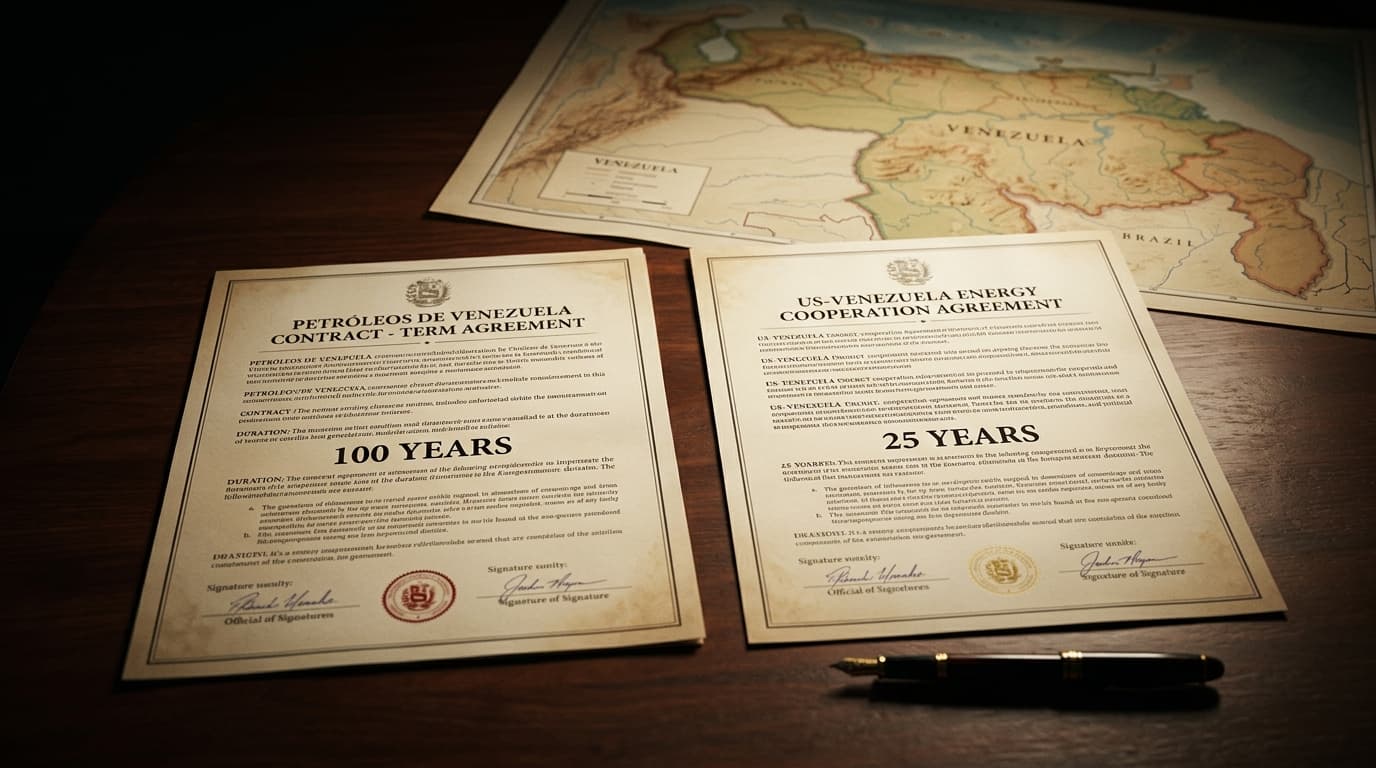
The White House says it's a 100-year deal. The Venezuelan government, which signed the exact same document, says it's 25. Both versions are official. Neither has explained the discrepancy. And the more you pull on this thread, from the oil agreement between the US and Venezuela to the military operation that made it possible, the more the same question resurfaces: who is calling the shots in this relationship, and who is simply signing what is put in front of them?
From maduro's capture to the largest oil deal in history
To understand why a single contract can have two official durations at the same time, one must go back eight months to the moment Venezuela ceased to have an elected president in power.
On January 3, 2026, United States forces conducted a military operation in Caracas, capturing President Nicolás Maduro and his wife, Cilia Flores, and transporting him to New York to face narco-terrorism charges. The casualty count of that operation was never clear and remains unverified: Cuba confirmed 32 of its own military personnel killed, while independent journalistic accounts reported numbers ranging from 24 to nearly 100 total deaths depending on the source. To this day, there is no single, uncontested official death toll, a pattern of unreconciled official narratives that repeats throughout this entire story.
Two days after the operation, Vice President Delcy Rodríguez assumed office as interim president before a National Assembly dominated by Chavism. In the following weeks, that same Assembly passed a reform of the Organic Hydrocarbons Law, formally opening the door to foreign capital, while the US Department of the Treasury gradually lifted sanctions that had blocked American oil companies from operating in the country for years. In other words: the legal groundwork for a deal like this did not appear overnight in August; it was methodically constructed throughout the first half of 2026, with Washington dismantling its sanctions while Caracas dismantled its laws.
Who controls the oil exploration
It was only eight months after Maduro's capture, on August 28, 2026, that Washington and Caracas announced what the Trump administration dubbed "the largest oil deal in history." The entity chosen to manage exploration is North American Blue Energy Partners (NABEP), controlled by Venezuelan businessman Alejandro Betancourt López, and this is where the narrative gains another layer of complexity.
This is not a minor detail. The agreement grants NABEP concessions over 17 oil fields containing approximately 65 billion barrels in proven reserves, positioning the firm as the direct vehicle for US government involvement: the Strategic Capital Office of the US Department of War (the official name of the former Department of Defense following a September 2025 executive order) holds a 35% stake in NABEP's parent company at no cost to US taxpayers, according to the White House. Furthermore, the US secures the right to purchase 20% of all production at cost price and right of first refusal on the remaining 80%. In short, the nation acting as exploration partner is simultaneously a 35% owner of the operating firm and the primary buyer of nearly all output, an arrangement that highlights the risks of dependence on natural resource extraction and goes far beyond a simple "partnership."
The contradiction neither side explained
Agreement duration according to Washington vs Caracas
The White House describes 100-year concessions. Delcy Rodríguez, speaking on Venezuelan television, presents a 25-year binational project. Both statements are official.
It is precisely over this leverage that the two versions of the agreement diverge. According to the White House, it is a 100-year concession. According to Delcy Rodríguez's public statements, it is a 25-year binational project aiming for production above 1.5 million barrels per day, with minimum royalties of 16% and an income tax rate of 34%. The two versions agree on at least one metric: Venezuela is expected to receive between $200 billion and $209 billion in royalties and taxes over the first 25 years, indicating both sides are referencing the same financial figures, even if not the same timeline.
It is like two parties presenting different copies of the same lease, each with a different end date handwritten on the document, neither offering an explanation. What makes this more than a bureaucratic oddity is the sheer scale involved: Venezuela currently produces around 1.2 million barrels per day, roughly one-third of its pre-1999 output. Rebuilding production at the pace promised in both versions will require tens of billions of dollars and years of labor, enough that the gap between 25 years and 100 years is not a footnote, but literally the difference between one generation and five.
While this contradiction remains unexplained, the broader energy sector is already shifting position. Chevron finalized a separate deal that same week, pledging over $7 billion in investment over the next five years to more than double its own Venezuelan production. European major energy firms such as BP, Shell, and Repsol have also begun returning as OFAC sanctions lift, whereas firms like ConocoPhillips chose to stay out, citing internal corporate governance rules. Even within the industry, some see this as an immediate opportunity while others prefer to watch from the sidelines until the duration issue is clarified.
Who was left out of the deal
While major companies weigh participation, on the political front one prominent name is virtually absent from both official versions: Maria Corina Machado.
The Venezuelan opposition leader received the 2025 Nobel Peace Prize for her advocacy of democratic rights. Edmundo González Urrutia, the candidate who replaced her in the 2024 election after she was barred from running, had been recognized by the US as the legitimate winner of that vote. Neither participated in the oil negotiations nor issued public statements about the deal, a silence that, for two figures typically active on social media, is telling in itself.
It is like negotiating the lease of a house without inviting the owner to the table. And this exclusion is not limited to the opposition: even the Chavist camp itself is divided. Justice Minister Diosdado Cabello had publicly advocated in 2025 for cutting off oil sales to the US in the event of an attack, yet pivoted as soon as Trump expressed interest in purchasing resources, a 180-degree turn criticized by internal opponents. Figures from original Chavism, including former PDVSA head Rafael Ramírez and former Vice President Elías Jaua, went further, publicly labeling the deal unconstitutional. Ramírez compared it to the Development Fund for Iraq established by the US following the 2003 invasion, a heavy comparison coming from any analyst, but carrying added weight coming from within the governing party.
What lies ahead, and why timing matters
None of this is happening in isolation. The agreement was announced days after the US and Israel resumed strikes against Iran, sending US gasoline prices past $4 per gallon. In an extensive New York Times interview, Donald Trump declined to set a timeline for ending US oversight in Venezuela or holding elections, though he maintained the deal would lower domestic fuel prices "over the long term." Secretary of State Marco Rubio had previously presented a three-phase transition plan (stabilization, economic recovery, power transition) without a firm deadline for the final stage, suggesting "transition" may remain an open-ended term.
This indefinite timeline sits alongside a very concrete deadline on the US political calendar: the midterm elections on November 3, 2026. An agreement promising lower gas prices, unveiled weeks before a crucial congressional vote, represents the kind of timing that is rarely accidental.
The current situation presents clear elements: a second round of talks with the Venezuelan opposition set for September 15 that excludes energy policy; an agreement undergoing active implementation with Chevron investing and other majors deliberating; and two official versions of its duration that neither Washington nor Caracas has reconciled in public. A contract whose duration the signing parties cannot state consistently in public is not a deal between equals: it is the clearest illustration yet of who commands the relationship.

Discussion
Comments
Leave your thoughts on this article.
Loading comments...