
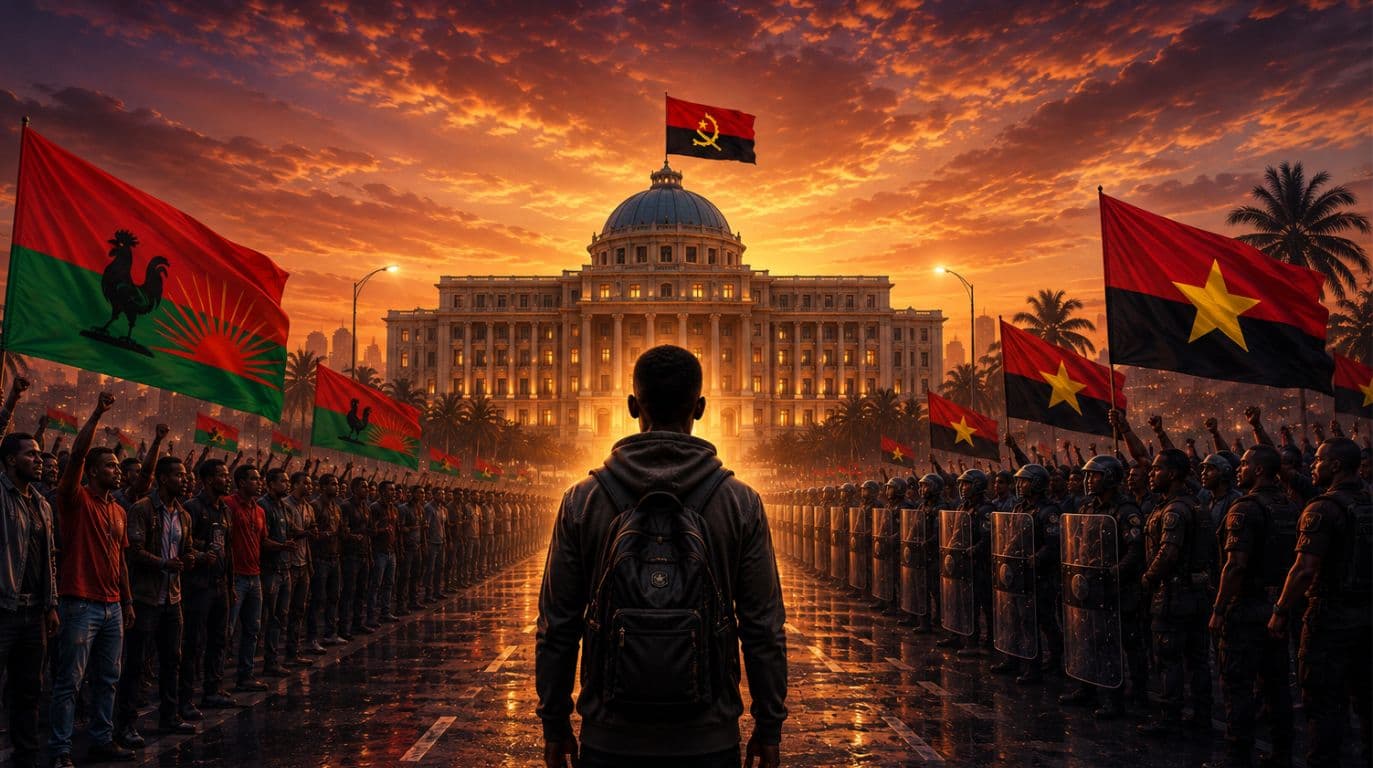
In 2021, one year before the 2022 elections, I was riding in a crowded shared taxi on my way home from school. As is typical in Angola, the minibus carried about sixteen people, and among them a conversation about politics broke out. I didn't participate, I just listened, still young, curious, simply wanting the best for my country. It was there that I heard, for the first time, one of the passengers describe what he would do if his party won power. Five years later, with Angola heading toward the 2027 general elections, I still think about that conversation whenever someone asks me: if MPLA loses the 2027 elections, will Angola go to war?
It is a serious question. But, as you will see, it is poorly framed, and the reason lies right inside that taxi.
The taxi where this subject began for me
I was just a student heading home from school, sitting among strangers in the kind of crowded taxi that is part of daily life in Angola. I wasn't part of the conversation, I was just listening.
It was there that I heard someone describe what they would do differently from the MPLA if their party took office. And the answer wasn't to reform the system, it was to copy it. Change the flag, rewrite the national anthem, occupy the exact same position of privilege that was being criticized in the ruling party. Not out of ideology, but out of envy. Paying back in the same coin.
It was there, in that taxi, that I realized an uncomfortable truth: the fear of losing power and the temptation to abuse it, in the exact way one criticizes in an opponent, do not belong to one specific party. They belong to anyone who has never had to share power with a real political rival.
It is through that lens, not "MPLA good, UNITA bad" or vice versa, that I will answer the question in the title. And it begins with a fact every Angolan knows by heart, but rarely stops to weigh properly.
Mpla has never lost an election, and that changes everything
Let's start with the simplest and most crucial fact: since the introduction of multiparty democracy in Angola in 1992, MPLA has never lost a general election. Not one. In nearly 35 years of multiparty elections, power has never changed hands through the ballot box.
This is not an opinion, it is verifiable electoral history. And that is precisely why 2027 is different from any previous Angolan election: for the first time, an opposition victory is no longer a purely theoretical scenario.
In 2022, MPLA won with roughly 51% of the vote against UNITA's 44%, the narrowest margin in history, with voter turnout standing at just 44.82%.
Five percentage points. That was the distance between "MPLA continues" and "Angola changes its ruling party for the first time in 47 years." And it is that same narrow margin that explains the fear that follows: when the distance between winning and losing becomes so slim, those in power feel, for the first time, that they have something concrete to lose.
Who controls what: state and party entangled
That fear on the MPLA side does not come out of nowhere. The reason why so many people fear a violent transition is not irrational, it is structural.
Provincial governors and municipal administrators in Angola are overwhelmingly MPLA cadres. This has led, in documented instances, to situations where lawmakers from opposition parties, particularly UNITA, face unequal treatment during official institutional travel that should be strictly neutral.
The most recent and serious example occurred in August 2026 in Uíge province: clashes between the National Police and UNITA activists and MPs left at least 31 injured, including parliamentary leaders such as Arlete Chimbina and Albertina Ngolo. Days later, on August 12, a motion of protest regarding the incident was voted down in Parliament by the MPLA majority.
It was not an isolated event. In July 2025, nationwide protests against the removal of fuel subsidies, coinciding with 50 years of independence, resulted in at least 5 deaths and over 1,200 arrests. It was the most serious civil unrest since the end of the civil war.
It is in this environment that a widespread belief gains traction among Angolans: that President João Lourenço himself once stated publicly that non-party members would never hold jobs or senior positions.
This pattern, confirmed by the president himself on two separate occasions, forms the real basis for widespread anxiety. Yet there is a part of the story that this fear alone does not explain.
The turning point few are noticing
If the picture above were the entire story, the answer to the title question would be a simple "yes": MPLA controls everything, so it will never allow itself to lose. But two recent developments complicate that simple conclusion.
First: in December 2025, MPLA and UNITA jointly approved a revision of the Angolan electoral law that removes direct central control over vote counting. Until then, final tallying was centralized in Luanda, the most distrusted point of the entire electoral process. From now on, each polling station tallies and publishes its own results publicly on site.
It is not a guarantee of a clean election. But it shows the party that allegedly "will never let itself lose" helping to design a mechanism that makes manipulating its own victory significantly harder.
The second development is on the other side of the board: the UNITA of 2027 is not the UNITA of 1992. Adalberto Costa Júnior was re-elected party leader in November 2025 with roughly 91% of delegate votes, and launched his presidential campaign in July 2025, more than two years before the election. Today's UNITA has formally invited the European Union, the United States Congress, and the Carter Center to observe the 2027 elections.
internal support for Adalberto Costa Júnior
Percentage of delegate votes re-electing Costa Júnior as UNITA leader in November 2025, consolidating his leadership over two years before the 2027 election.
It is a deliberate strategy: to make any eventual victory impossible to dispute without international evidence, unlike what happened in 1992. And it is precisely 1992 that we must examine closely to understand what has changed, and what has not, since then.
1992 is not 2027
Hovering over this entire discussion is a ghost: 1975 to 2002, the 27 years of civil war that followed independence, with a brief electoral interlude in 1992.
civil war fatalities in Angola
Widely cited estimate of fatalities between 1975 and 2002, alongside more than 1 million internally displaced persons over the conflict.
It was in 1992 that Angola had its first and only real experience of "losing an election": UNITA rejected the results and immediately resumed the war. It is that precedent, rather than 1975, that weighs heaviest on current fears.
Yet there is a structural difference between 1992 and 2027 that almost no one mentions: in 1992, UNITA possessed an organized army ready to resume combat the day after defeat. Today, that parallel armed force no longer exists in that form.
This does not mean the risk of violence has vanished. The events in Uíge in August 2026 prove otherwise. It simply means that the most flammable element today is no longer a rival army ready to march. It is something else, harder to extinguish with a ceasefire: decades of built-up frustration from people feeling they never had a turn, regardless of who holds power. And that is precisely where the answer to the title question stops being about statistics and starts being about something else.
What really decides whether there is war
We arrive, then, at the central point, and the reason why the question "will there be war if MPLA loses?" is poorly framed.
João Lourenço is constitutionally barred from seeking a third term in 2027. The 9th Ordinary Congress of the MPLA, scheduled for December 9-10, 2026, will decide who leads the party into that election, with candidates such as Higino Carneiro (whose candidacy was annulled and is currently before the Constitutional Court), António Venâncio, and José Carlos de Almeida. In other words: even within the MPLA itself, 2027 will be an election without Lourenço at the top of the ticket for the first time since 2017.
And here is where that taxi conversation comes back into focus. What decided, in 1992, that UNITA's defeat would end in war was not just the ballot count, it was the conviction on both sides that there was no place for the loser after victory. It is the same instinct I heard in 2021, in a conversation that didn't promise to dismantle power, but rather to copy the very abuse of power it criticized. And it is the same instinct that Lourenço himself admitted existed within his own party in March 2026, when proposing quotas to fix decades of unequal access.
The question that will decide Angola's fate in 2027 is not "who will win." It is this: whoever wins, whether the successor chosen at the MPLA Congress in December or Adalberto Costa Júnior for UNITA, is there a genuine plan to govern with those who lost? Or just another winner ready to repeat the same pattern of exclusion that fueled the fear in the first place?
The answer to that question, far more than any number in a ballot box, will determine whether 2027 goes down in history as an election, or as the start of something else.

Discussion
Comments
Leave your thoughts on this article.
Loading comments...