
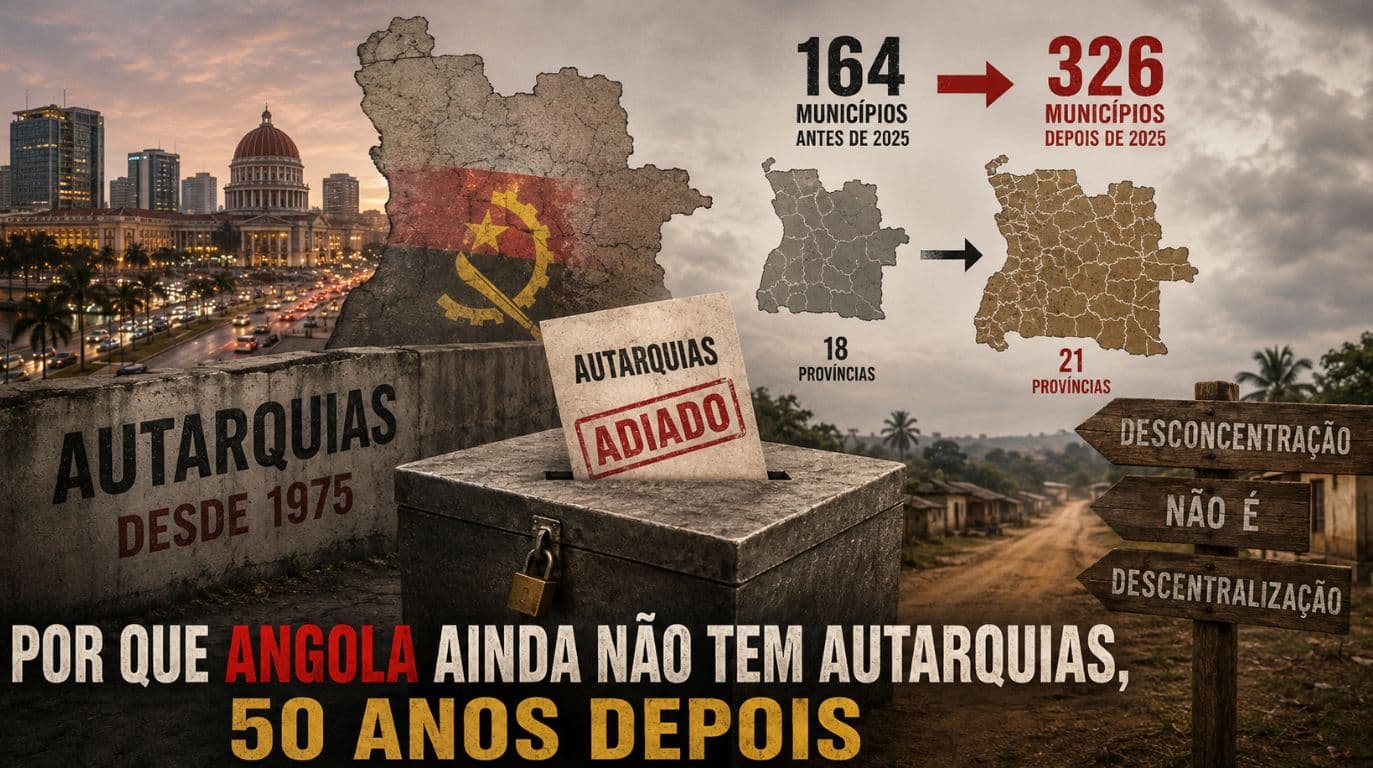
In 2022, the opposition won in Luanda for the first time. Three years later, the government doubled the number of municipalities in the country. This is not a conspiracy theory. It's just two dates, and the explanation for why Angola still has no local elections starts right here.
What is a local municipality, and what Angola has today instead
A local municipality (autarquia) is a public corporate body, distinct from the central State, with organs directly elected by residents: an executive municipal council, a mayor, and a deliberative municipal assembly. Today in Angola, none of this exists. Municipal and communal administrators are appointed by provincial governors, who in turn are appointed by the President of the Republic. This is administrative deconcentration, not true decentralization.
A promise spanning three constitutions
The first Angolan constitutional law, in force since midnight on November 11, 1975, already provided for the institutionalization of local municipalities in Article 51. The 1992 constitutional law, in a multiparty context, maintained that provision in Article 14. The 2010 Constitution preserves the principle of local autonomy. Three different legal documents over five decades, and the promise remains exactly where it started.
The coincidence that numbers cannot hide
Here is what most coverage on this topic leaves out. According to published academic analysis, the MPLA has lost roughly 10% of votes in each successive general election since 2008. In 2022, this erosion produced a symbolic outcome: UNITA won in Luanda, the capital that concentrates about 40% of the country's urban population and drives much of its economic activity.
Votes lost by MPLA per general election since 2008
According to published academic analysis. In 2022, this erosion resulted in UNITA's victory in Luanda, the country's capital.
Three years later, on January 1, 2025, a new political-administrative division came into force: Angola expanded from 18 to 21 provinces, and from 164 to 326 municipalities, more than double. Luanda alone went from 9 to 16 municipalities.
Municipalities in Angola before and after 2025
Luanda alone expanded from 9 to 16 municipalities. Official justification is reducing regional imbalances; academic consensus is that it further delays any local election calendar.
Doubling the number of municipalities to prepare just when pressure for local elections increases is like promising to build a house as soon as all materials arrive, and then, whenever materials are almost ready, deciding to double the size of the house.
Even when the law exists, institutional design favors the ruler
Even in the approved parts of the legislative package, details consistently weigh on one side. Law 3/20 allows political parties to form electoral coalitions for local elections, but forbids independent voter groups from doing the same. Furthermore, established parties enter local elections with State budget funding from prior general elections, while independent civic groups, requiring 150 signatures just to register, start with no such funding.
Then there is administrative supervision: oversight of municipalities belongs to the President of the Republic, who delegates it to provincial governors. Because governors are typically also provincial first secretaries of the ruling party (a dynamic also evident in political crises like the MPLA internal dispute), this creates a structural roadblock whenever an opposition mayor needs approval for local governance programs.
The warning from mozambique
Some argue Angola should simply move fast. The recent history of Mozambique suggests how decentralization happens matters as much as the fact itself. Mozambique's municipal process, launched in 1997 with just 33 municipalities, was gradual and uneven across regions. According to an academic legal scholar involved in that reform (hired at the time by the World Bank), this uneven gradualism was linked to renewed armed instability in the central-northern region in the 2010s, leading to a 2018 constitutional revision that created elected provincial assemblies.
Angola carries its own historical trauma in this equation: the 1992 general elections were followed by a second civil war, which ended only in 2002.
What remains to be seen
There is still no fixed date for Angola's first local elections, and it remains unclear whether they will happen before or after the 2027 general elections. One proposal already on the table suggests a phased rollout, institutionalizing local municipalities gradually across the 55 largest municipalities over 15 years rather than all 326 at once, an approach that would echo Mozambique's own gradualism, for better or worse. The law has promised local autonomy for five decades. Recent electoral shifts, MPLA's loss of Luanda, and doubling municipalities do not prove intent on paper. But they leave the word "coincidence" feeling very uncomfortable.

Discussion
Comments
Leave your thoughts on this article.
Loading comments...