
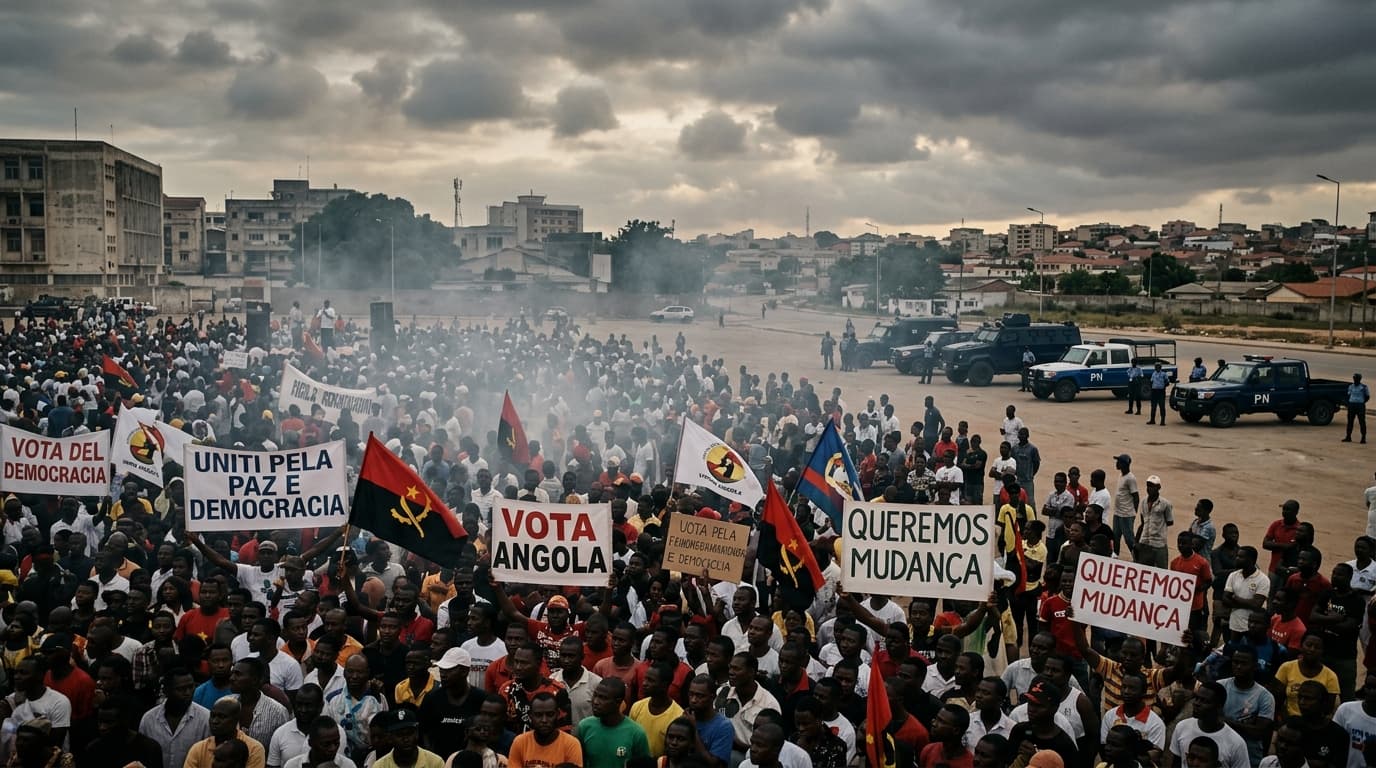
Noon, Saturday, August 8, 2026. In the city of Uíge, a vehicle carrying a political leader is shot at, tear gas fills the air, and a few hours later, the president of Angola's largest opposition party accuses the State of creating a "state of war." This is how UNITA in Uíge became, overnight, the epicenter of a confrontation that almost no one in Angola agrees upon.
What happened in uíge, hour by hour
The event scheduled to take place in Uíge was no ordinary rally. It marked the 92nd anniversary of Jonas Malheiro Savimbi, founder of UNITA, born on August 3, 1934. For a party born out of the struggle for independence that endured decades of civil war before becoming an electoral opposition force, this is not a minor symbolic date, as it represents an identity ritual.
The arrival of adalberto costa júnior and the police siege
Adalberto Costa Júnior, president of UNITA, arrived in Uíge on Friday, August 7, to personally preside over the central ceremony. The following day, the National Police surrounded the party's provincial headquarters and blocked access routes, effectively preventing militants and the party president himself from reaching the planned venue.
Live bullets at noon: eyewitness accounts
It was around noon on Saturday that the situation escalated. According to the account of Nelito Ekuikui, Secretary-General of JURA (UNITA's youth wing), police began firing tear gas and live ammunition. Ekuikui himself reported being directly targeted in a vehicle attack, but escaped unharmed after being assisted by local citizens.
The population did not react, they threw nothing.
Independent journalistic sources confirm at least two injured people, one of them shot in the foot. This represents the absolute minimum baseline of confirmed facts, but it is by no means the only figure reported.
Two versions, one confrontation: UNITA vs. national police
From this point onward, accounts diverge significantly.
Adalberto Costa Júnior accused local authorities of creating a virtual "state of war" in Uíge, eventually postponing the central event honoring Savimbi. The National Police justified their intervention by stating that UNITA intended to hold the political activity in an "unsuitable location" near the courthouse, while criticizing the closure of public roads for political events, without publicly addressing the number of casualties or the use of live ammunition.
The Bloco Democrático, a platform of political parties and civil society organizations, went further, reporting "dozens" of serious injuries caused by live fire, physical assaults, and tear gas. They classified the event as "brutal repression" and an undeclared "state of siege" that paralyzed commerce and freedom of movement across the city.
Which version is accurate, who violated the law first, and how many people were actually injured? No independent journalistic source consulted in this investigation resolves this dispute conclusively. This very uncertainty, more than any single detail, remains the most concerning aspect for observers.
Across the border, reaction came swiftly: RENAMO, Mozambique's main opposition party and another former guerrilla movement turned political force like UNITA, publicly condemned the "disproportionate use" of police force against the Angolan party.
Not an isolated incident: the pattern behind Uíge
An isolated incident would already be grave. But Uíge did not happen in a vacuum, and to see why, it helps to look further back than "police and UNITA clashed again."
UNITA was founded in 1966 by Savimbi, and spent from 1975 to 2002 in a civil war against MPLA that only ended with the founder's own death, the moment the party traded weapons for electoral politics for good. Two decades of peaceful political life later, in 2022, during the most closely contested general election in Angolan democratic history, MPLA won with approximately 51% of the vote against UNITA's 44%, a result contested by the opposition without gathering sufficient organized evidence to overturn it. It is directly to that moment that Nelito Ekuikui referred when warning that this time the party "will not appeal for calm" as it did then: a clear sign that UNITA's internal patience is wearing thin, and that Uíge is not just about one rally, it is about how much is left of that peaceful 2002 transition.
UNITA vote share in the 2022 general election
Compared to MPLA's ~51% in Angola's most contested election, serving as the benchmark Ekuikui cited when warning that the party will not urge calm this time.
That impatience has a concrete reason behind it: Uíge is not an isolated case. In April 2024, a UNITA convoy was attacked, leaving one person dead and six injured. Placed side by side with what just happened, the pattern is clear: a clash every political cycle, always with the same ending, conflicting accounts and no one ever held accountable.
Unanswered questions
That is why Uíge does not end with a neat conclusion. It leaves an uncomfortable question: when even the casualty count lacks consensus, and this is already the second episode of violence against UNITA in a little over two years, what shared truth remains between the government and opposition in Angola? As of now, no independent investigation has answered this question, and that very absence continues to define the nation's political landscape.
Discussion
Comments
Leave your thoughts on this article.
Loading comments...