
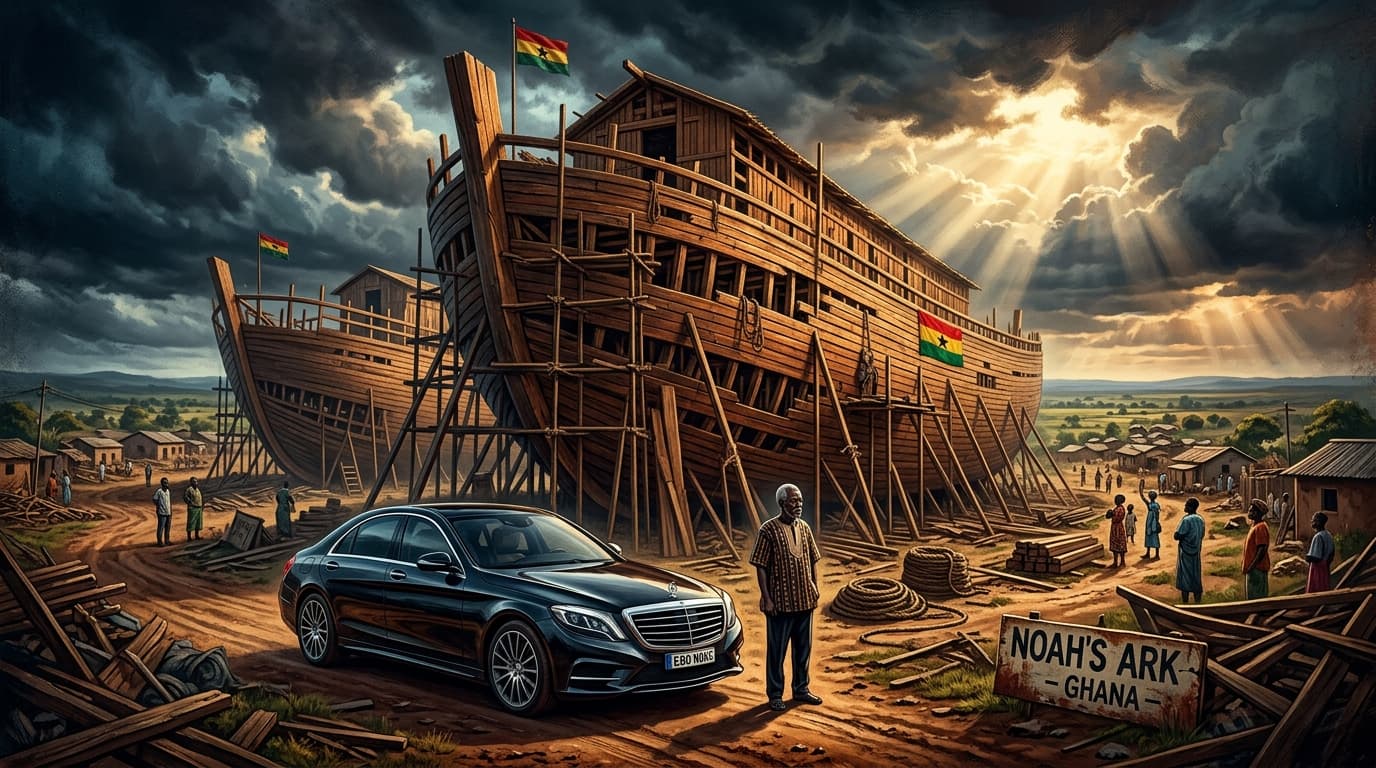
Imagine the following scene: you work hard your entire life to buy a home, cultivate your land, and secure your family's future. Suddenly, someone appears in your town claiming God spoke to him in a dream, declaring that on December 25th, Earth will be submerged by a catastrophic flood lasting three years. To save yourself, there is only one escape: donate your money to build massive wooden arks under this new leader's command.
Sounds like a fictional medieval tale, doesn't it? Yet this happened in late 2025 in the Kumasi region of Ghana.
The case of the self-proclaimed prophet Ebo Noah (the "Noah of Ghana") is not merely another news story about a fraudster. It is a striking x-ray of how fear, economic uncertainty, and social media algorithms can unite to paralyze the reason of hundreds of thousands of people.
The birth of the prophecy: who is ebo noah and the promise of the 8 arks
Throughout 2025, Ebo Noah rose to prominence declaring he carried a direct spiritual mission continuing the biblical book of Genesis. According to him, the Creator of the universe had chosen his sleep as a conduit to warn humanity: an apocalyptic flood would begin precisely on Christmas Day.
To give visual form to the nightmare he preached, Noah didn't stop at words. He launched the construction of 8 colossal wooden arks in the city of Kumasi.
As his speeches grew more urgent, panic spread. Entire families began selling land, livestock, homes, and life savings accumulated over decades. Workers abandoned formal jobs, children were pulled from schools, and crowds marched toward Kumasi to secure a spot aboard the wooden vessels.
Collective delusion: why did so many people sell everything?
It is easy to look at this story from a distance and label the victims as naive. But sociology teaches us that nobody wakes up on an ordinary day and decides to hand over everything they own to a stranger without underlying context.
In societies facing economic volatility, unemployment, and social crisis, the human mind desperately craves certainty. Apocalyptic prophets offer precisely that: absolute answers in a confusing world.
The DIGITAL MANIPULATION MECHANISM
| Phase | Description |
|---|---|
| 1. SOCIAL CRISIS | Economic insecurity generates collective anxiety. |
| 2. ABSOLUTE DISCOURSE | The prophet emerges offering certainty & salvation. |
| 3. DIGITAL LOUDSPEAKER | Social media multiplies fear by 1,000x. |
| 4. SOCIAL VALIDATION | "If everyone is going to the ark, I must go too." |
Here enters the devastating role of the internet. Social networks did not create fanaticism, but they operate like stadium loudspeakers. A short video on TikTok or YouTube showing thousands gathered around an ark triggers the Social Validation Effect. Anyone in doubt thought: "If everyone else is going, I can't be left behind."
The day nothing happened: the silence of december 25th and the brand-new mercedes
December 25, 2025 finally arrived. The day marked for the end of times.
Thousands of followers gathered in Kumasi under the African sky. People looked up expecting heavy clouds, divine thunder, or the first raindrops of the promised deluge. But hours ticked by. Noon came, afternoon passed, and the sun continued to shine brightly. Not a single drop of rain fell.
The silence that followed was deafening. For families who had burned all bridges with the real world, the absence of rain brought no relief, but the start of an emotional and financial nightmare.
To make matters worse, local investigations and news reports exposed the ultimate contradiction: while believers handed over their last coins to buy timber, Ebo Noah was comfortably driving a brand-new luxury Mercedes-Benz, acquired using community donations.
The psychology of cognitive dissonance: how lies reinvent themselves
You might ask: when the flood failed to arrive, did everyone immediately realize the fraud and confront the prophet?
The surprising answer is: not everyone. And science explains why.
In 1956, social psychologist Leon Festinger studied a doomsday cult in the United States and formulated, in the book When Prophecy Fails, the theory of Cognitive Dissonance. When a person makes a monumental sacrifice for a belief (such as selling their house) and that belief proves false, the pain of admitting "I was tricked and destroyed my life" is so unbearable that the brain prefers to seek any surreal justification to preserve the illusion.
Ebo Noah masterfully exploited this vulnerability. Facing the failure of his prophecy, he did not apologize. He simply shifted the narrative, declaring:
"God's mercy was activated by our faith. God saw the queues at the arks and decided to postpone it. The apocalypse was not canceled, only extended."
Many followers, clinging to what remained of their dignity, breathed a sigh of relief and accepted the new explanation. However, the charade did not last long. In response to public panic and fraud reports, Ghanaian police authorities intervened and arrested Ebo Noah for scamming and inciting public disturbance.
The boundary between faith and critical thinking
The story of Ebo Noah is not an isolated event about one man and a luxury car in Ghana. It is a universal lesson on human vulnerability during times of uncertainty.
Faith, spirituality, and hope are noble forces that move the world. However, when faith demands that you switch off your critical thinking, abandon your duty to your family, and hand your future to someone promising magical shortcuts, it ceases to be devotion and becomes manipulation.
Ghana's Christmas prophecy brought no rain from heaven, but left a storm of lessons on earth. The greatest lesson is that in a world filled with noise and false saviors, the courage to question and think independently remains our strongest ark of protection.
_


Discussion
Comments
Leave your thoughts on this article.
Loading comments...