
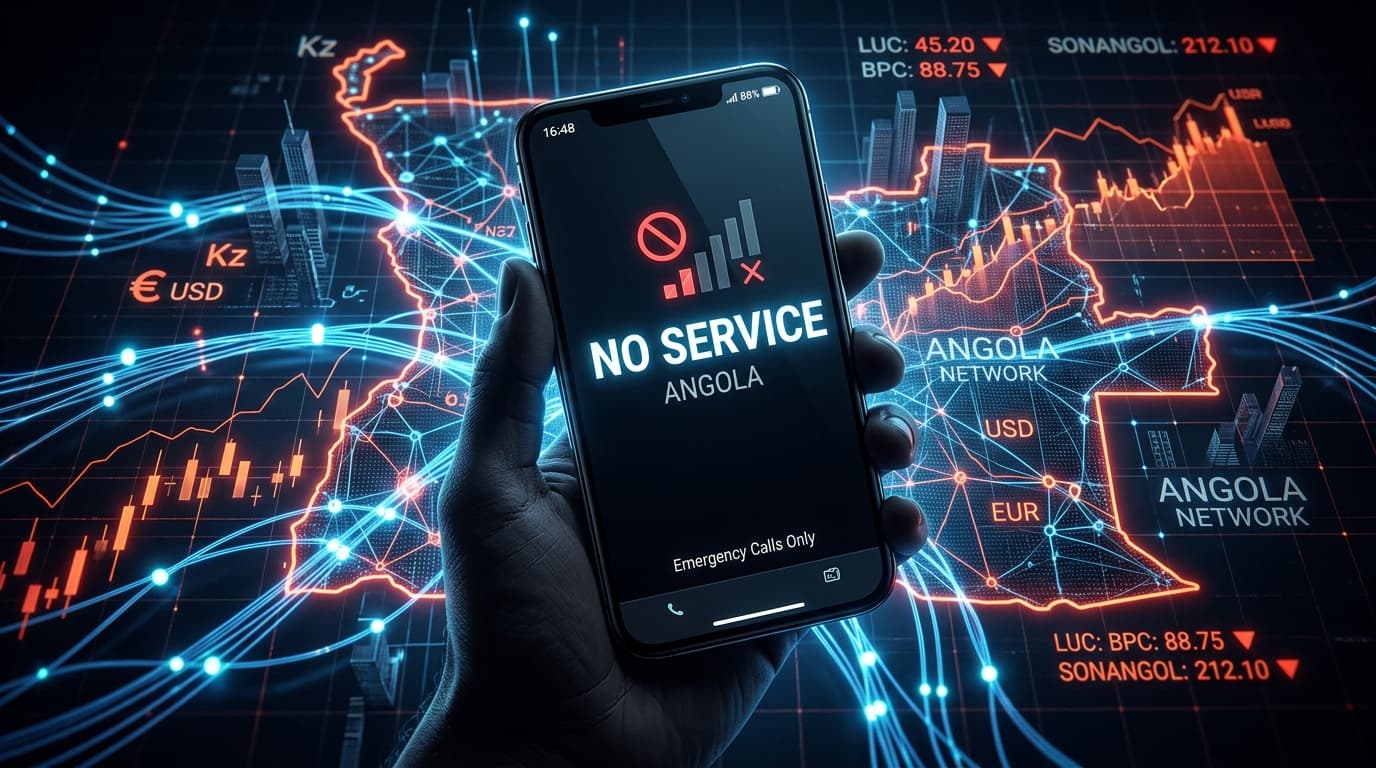
In the early hours of July 29, 2026, millions of Angolans woke up to a disturbing sight on their phones: the network icon had vanished. Suddenly, making an emergency call, sending a message on WhatsApp, or paying for bread at an ATM turned into an impossible mission. The country's largest telecommunications operator, responsible for 76% of the market and over 20.8 million Yet while panic spread across messaging groups and unfounded rumors circulated that the telecom giant had gone bankrupt, something unbelievable was taking place behind the scenes of the financial markets: just hours later, Unitel staged the largest initial public offering (IPO) in Angola's history, raising over 300 billion kwanzas on the stock exchange.
How can a company smash billion-dollar records on the stock market at the exact moment its primary service leaves an entire nation in a digital blackout? I dug into the official data to understand this fascinating story, and what I discovered reveals an urgent lesson about technological sovereignty.
What actually brought down the network? A perfect storm
When a mobile phone loses signal for hours, most people's first instinct is to assume a simple glitch or speculate about conspiracy theories. However, the technical truth disclosed by Unitel's Board of Directors revealed something far rarer and more severe: a triple combination of catastrophic incidents.
It all began on July 28 at 08:40 AM, when public infrastructure roadworks severed the main fiber-optic cable in the Sangano region. On its own, this would already require traffic rerouting. However, at 1:40 PM, the backup line located at the Angonap data center suffered a technical failure as well.
The final blow landed the following morning at 02:20 AM, when the operator's core systems suffered a large-scale malicious cyberattack. According to global data from Cloudflare Radar, internet traffic in Angola plummeted dramatically, operating at a mere 13.6% of its normal capacity.
The 300 billion kwanza paradox on the bodiva exchange
This is where the story takes a turn worthy of a movie script. While merchants in Luanda and Benguela struggled to operate without card payment terminals and ride-hailing drivers were left stranded, screens at Bodiva (Angola's Debt and Stock Exchange) registered a historic milestone.
The Angolan State, through IGAPE, completed the sale of a 15% stake in Unitel. Investor demand exceeded the available shares by an impressive 120%, fixing the share price at the upper limit of the range (40,040 kwanzas) and attracting 11,264 new shareholders.
| Operation Metric | Registered Value on Bodiva |
|---|---|
| Total Raised | 300,300,000,000 Kz (~€300M) |
| Demand vs Offer | 120% Oversubscription |
| New Shareholders | 11,264 citizens and institutions |
| Previous Record (Banco BFA) | ~120,000,000,000 Kz |
Why didn't the financial market panic during the blackout? The answer lies in rational investment analysis: institutional investors evaluate long-term assets, cash generation, and market capacity. Nevertheless, the incident made it clear that the 16.3 billion kwanzas earmarked in the company's Capex for IT systems through 2026 must be accelerated immediately to bolster cybersecurity and data redundancy.
The danger of putting all digital eggs in one basket
Imagine a major metropolis where 80% of residents rely on the exact same bridge to commute to work, shop, and reach hospitals. If that bridge closes, the city doesn't disappear, but it grinds to a complete halt.
The Unitel blackout exposed the vulnerability of a nation that concentrated much of its digital payments, emergency communications, and essential services onto a single infrastructure. Competitors like Africel, which currently leads in mobile internet speeds according to tests by French platform nPerf, have been gaining ground by focusing on network quality in major urban centers.
For consumers who suffered losses due to expired plans or lost balances during the crisis, official complaint channels (such as line 19192, support email, and the Reclame Aqui Angola platform) are the formal mechanisms to claim legally guaranteed compensation.
What is the takeaway?
Before closing, it's worth putting to rest a common fear this episode raised: was customers' personal data ever at risk? According to preliminary technical reports from the operator, digital solutions and cloud backups remained intact, which allowed the incident to be contained and voice and data services to be gradually restored without loss of operational integrity. In other words, the blackout was severe for access, but it does not appear to have been a data breach.
The event of July 29, 2026, will be remembered as a turning point in Angola's technology history. It demonstrated that having a billion-dollar telecom giant is a point of national pride, but ensuring an entire nation doesn't freeze because of a single point of failure is a matter of security and digital sovereignty.
Were you affected by the blackout? Were you able to recover your balance or did your business suffer losses?



Discussion
Comments
Leave your thoughts on this article.
Loading comments...